Taxes included.
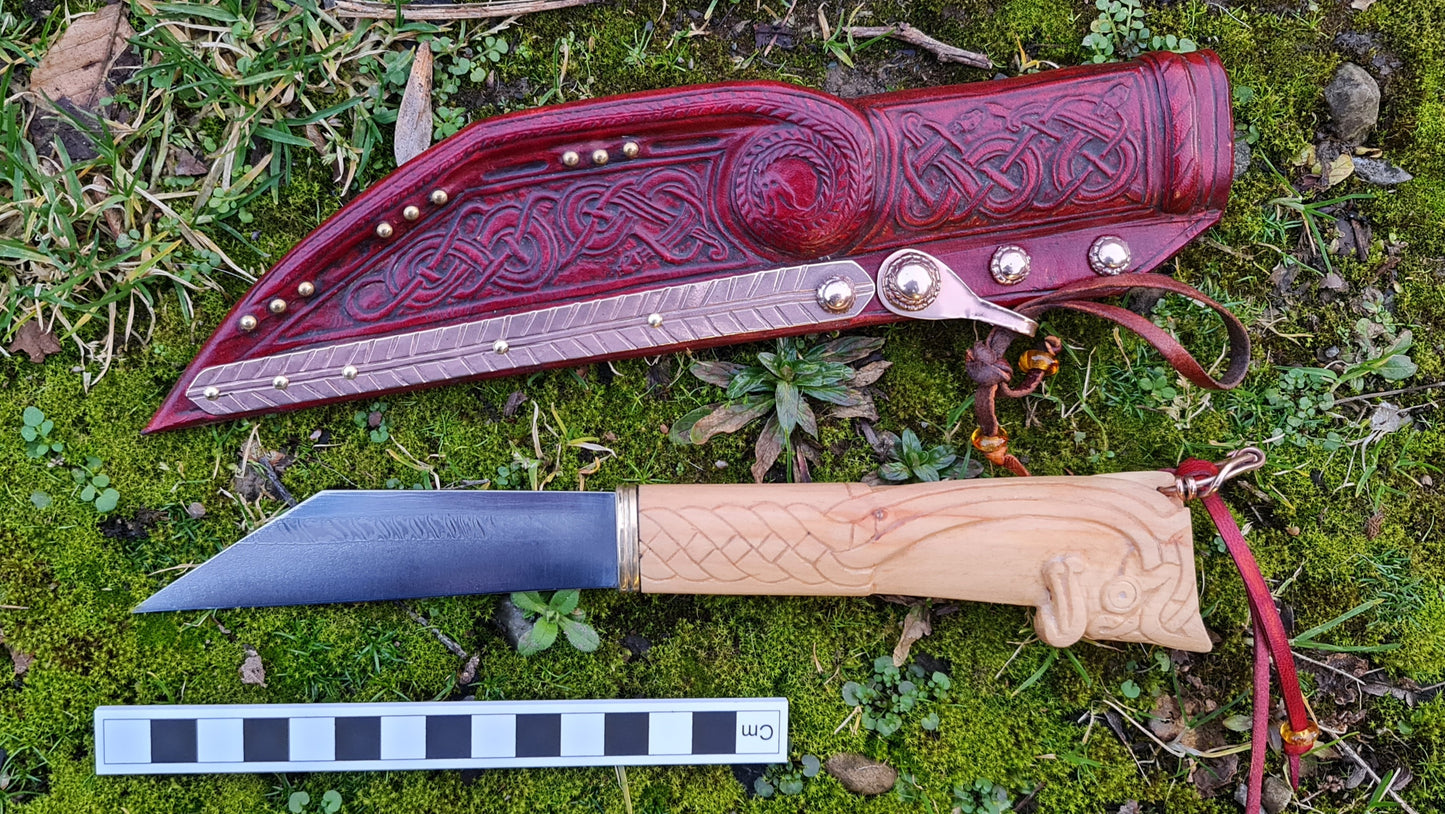
A Type IV, late 10th Century feasting knife!
The blade is hand forged, with a high carbon steel edge, a 9 layer twisted pattern weld, and antique wrought-iron spine. I forge welded the billet pretty close to shape, allowing me to get a narrow, tightly twisted pattern, full of runes and dancing goths!
Blade length: 11cm
Width at break: 25mm
Thickness on spine: 6mm
The handle is made from hawthorn, carved after a find from the Piccadilly excavations in York. You'll note the crest on the forehead and the flowing plumes, making me believe that, with the hooked beak, this is a representation of a Peacock.
The original, described as a possible knife handle, is made from boxwood, but I do like the hawthorn as a wood. My hawthorn is all claimed from local sources, and is cut 'in the round', giving quite a different appearance to the grain, than traditionally planked wood.
The copper-alloy bolster, is file worked and while not strictly period similar examples can be found in earlier periods, and I felt the handle needed something to finish it off nicely. I also added a copper-alloy twisted ring, mounted in a hole seen on the original, with a goat hide thong representing the Peacock's plumage, finished with glass beads from Tillerman.
For the sheath I've pulled together a variety of sources, to create something that represents the peak of what they could have created "in period", and to fill in the gaps.
It's made from 2mm veg tan, with a vellum lining used as a base for foundation moulding over cord work risers; with a half tunnel stitched seam, as seen on the majority of seax type sheaths, meaning that the stitches are only visible on the reverse.
The knotwork design on the face is taken from DLS 2 and DLS 3 from Dublin, as is the concept behind the moulded spine. In previous discussions George Ezell noted the similarity of the Parliament Street seax sheath with contemporary crosiers, many of which are serpent themed, which is what I've gone with here.
The moulded spine is also similar to the Parliament Street knife sheath, and creates a larger, more tool able field, and I've opted for decorating it in a fashion similar to Coppergate 15659. The geometric design on the reverse is inspired by several of the Dublin sheaths.
The moulded band, by the sheath mouth, is also inspired by a Dublin sheath, DLS 4, and the Parliament Street knife sheath; the latter also being the source for the truncated suspension flap.
The copper-alloy rivets along the front face of the spine are taken from DLS 11, with the remaining fittings taken from various York excavations.
The large, decorated studs; though the originals are gold, Anglo-Scandinavian Finds 10541, and lead alloy, Anglo-Scandinavian Finds 10556. Likewise the copper-alloy strip is based on Anglo-Scandinavian Finds 10390, from Coppergate.
The suspension loop is also inspired by a find of a hooked tag from Coppergate, Anglo-Scandinavian Finds 10436, which has a "fake" rivet dome tooled into the surface.
I did make this from sheet, though this isn't always the case for hooked tags; so, I hand hammered the hook to create an 'I-beam', a feature often seen on iron hooks and hinges.
I've opted for following the original seax sheaths, and have peened all the rivets without the use on washers on the backs. On many seax sheaths it's possible to see the indentation of rivet heads and plates on the front face, but not the reverse, suggesting they didn't use washers. From previous mistakes peening rivets, I can attest to the fact that even a half peened rivet is extremely difficult to remove from the leather!
The leather is dyed with a blend of modern chemical dyes, and an antique wax used to bring out some of the low lights. Tooling leather creates a colour contrast that is lost when using moderns dyes, so, this is an attempt to bring some of that contrast back.
It's all then finished with my blend of beeswax, goose tallow and Neatsfoot oil, adding a protective and waterproof finish. As is the knife handle.
In creating this piece my aim wasn't so much to produce something that an ancient warrior might have seen, but to recreate the feeling they had when they bought their new knife, when you buy yours!
There are nods to a modern aesthetic, but hopefully not at the cost of authenticity.